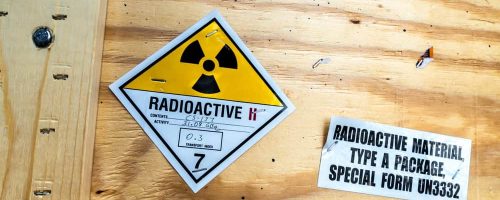
We live in a radioactive world.
The planet has had radiation since its formation around 4 billion years ago. And today that radiation is found in the air we breathe, the soil and rocks we live on, and the living things we consume to survive. It is literally everywhere! All life on Earth has evolved in this radioactive environment, including humans. The natural radiation that ancient humans would have been exposed to is not very different to what we experience today. The radiation that people are currently exposed to can be broken down into occupational exposure, medical exposure, and background (natural) radiation exposure. The goal of this blog post is to introduce the average Canadian to this concept of background radiation: what are the different types, where do they come from, and when should it be a cause for concern.
Radiation is a natural phenomenon. Like many other natural phenomena, humans have found a way to make use of it. This post will not go into the different uses of radiation in modern society but as a brief tour, radiation is widely used in healthcare, power generation, research, industry and security.
Keeping this in mind, it is important to acknowledge the other side of radiation: it carries risks to humans. The most concerning example of the risks of radiation are the nuclear bomb attacks on Hiroshima and Nagasaki and the reactor accidents at Chernobyl and Fukushima. The effects of excessive exposure to ionizing radiation are well understood. We know that ionizing radiation can cause DNA damage, possibly increasing the number of mutations and therefore causing a greater risk of developing a fatal cancer (IARC, 2012). We also know that massive amounts of radiation exposure can cause so much damage (killing off many cells in the human body) and leading to acute radiation syndrome or radiation poisoning/sickness (Johnson, 2017).
Is it paradoxical that we work with and make use of radiation while it poses such risks? This happens very often among humans. Many Canadians drive daily to get to work or for other purposes, even though driving is a very risky activity. Fire is a natural phenomenon with enormous destructive potential, yet it is used every day by billions of people around the world. Prehistoric humans had to balance risk (attacks from wild animals and other humans) and utility (hunting or foraging for food). To get to where we are as a species, we have had to live with and navigate risk. And we have done it by observing, learning and understanding, and by working together and helping each other. So, let’s learn about background radiation to better understand radiation in general, to help put the risks of radiation exposure in perspective.
Background radiation typically refers to ionizing radiation that an average person would come across outside of occupational or medical contexts. There are many types of background radiation, typically categorized as cosmic radiation, terrestrial radiation (radiation from the ground and things made from the ground’s materials), radiation in food and water, and radiation in air. We will talk about the first two categories in the next few paragraphs. The radiation that can be found in our bodies and in the air in our homes will be covered by another article.
Cosmic Radiation: Background Radiation from Space
Cosmic radiation is a relatively small part of our background radiation exposure. This radiation comes from the Sun and outer space. The Sun is an energetic ball of plasma that shoots out many charged particles and energetic beams of light. The more energetic types of light from the Sun include UV rays and gamma rays, both of which can give a dose of ionizing radiation. A larger contribution to your dose from cosmic radiation is cosmic rays. These are the energetic charged particles from the Sun and outer space. Because they are charged, they interact with the Earth’s magnetic field and usually do not reach the surface of the Earth. This interaction with the Earth’s magnetic field does create secondary radiation which does reach the surface, some of which is ionizing radiation. The radiation that reaches the surface will have travelled through the many layers of our atmosphere. As it travels through the atmosphere, this radiation interacts with the air molecules in the atmosphere and gives up some of its energy. Because of this process, there is less cosmic radiation at lower altitudes. Living in Lake Louise, Alberta (altitude of 1600 m above sea level) means that you have less atmosphere above your head and will receive more cosmic background radiation than living in Moncton, New Brunswick (altitude of 0 m, at sea level). Plane rides also expose passengers and aircraft crew to higher cosmic radiation. Astronauts receive massive doses of cosmic radiation every time they go into space as they have no atmosphere to protect them. For the average Canadian, the total dose from cosmic radiation comes to 0.3 mSv, with 10% of that from plane travel (based on an average number of plane trips). There is not much you can easily do to reduce your cosmic radiation dose. But the Sun also produces other kinds of radiation which are damaging to us (only some of which is ionizing), so putting on sunscreen every day is still a good health decision. You can check out our webinar on Sun Safety from June 2024 for more information. Links can be found here: https://radiationsafety.ca/services/webinars/.
Terrestrial Radiation: Background Radiation from the Earth
Terrestrial radiation is radiation coming from radioactive isotopes in the ground. As those isotopes decay, they will give off radiation, some which is penetrating enough to reach us living above the ground. Canada is rich in natural resources and some of those resources are isotopes of uranium, radium, and thorium. These and other isotopes exist in our soil and rocks in various concentrations. The Prairies and Rockies tend to have higher concentrations of radioactive isotopes and so there is a higher average terrestrial radiation dose if you live in those areas. On average in Canada, terrestrial radiation results in about 0.2 mSv of exposure each year, just under the average dose for cosmic radiation. There is not much that can be done about this background dose. Indeed, moving to a part of Canada that is close to sea level and low radioisotope concentration will reduce your annual dose slightly, but this background dose does not seem to affect cancer incidence in those areas. In fact, there are places in the world where the background dose is much higher (up to 10.2 mSv per year), such as Ramsar, Iran, and there are no established population level health effects observed from that higher background (Karam, 2001). For example, in Canada, the background terrestrial radiation in Yellowknife, Northwest Territories (NWT) is 1.4 mSv, about 7 times higher than the Canadian average of 0.2 mSv (CNSC, 2023), but according to a report from NWT Health and Social Services, “Cancer incidence in the NWT is the same as in Canada for all cancers combined” (NWT HSS, 2014, p. 1).
Can and Should You Do Anything About It?
As mentioned earlier, these types of radiation cannot be avoided entirely. Lining your home with lead will reduce this background radiation but not eliminate it to zero. And it may not be beneficial to reduce this background radiation anyway. We literally evolved within this radiation. And research has been done deep underground in lead-lined rooms to examine the effects of low background radiation on different model organisms. Overall, “… biological experiments conducted in underground laboratories have shown that cells cultured across both long and short periods in a low background (LB) environment compared with a standard background (SB) have shown that reducing the radiation background can have detrimental, rather than positive, effects.” (Lampe, 2017, p. 658). Another interesting connection between cosmic and terrestrial radiation is that terrestrial radiation is responsible for a lot of the heat produced deep underground in the Earth. Without this heat from radioactive decay, the core of the Earth would behave differently, potentially affecting the movement of the fluids that generate the Earth’s magnetic field. This field provides us with a lot of protection from cosmic radiation. So, if we somehow removed all the radioactive isotopes from the ground and reduced terrestrial radiation to zero, it could result in more cosmic radiation reaching the surface of the Earth.
In summary, all over the Earth, we are exposed to cosmic radiation and terrestrial radiation. There are variations in how much radiation can be measured depending on altitude and soil composition. These variations do not seem to affect the health outcomes of people living across Canada in terms of overall cancer incidence. This background cannot be reduced easily and reducing it does not necessarily result in any benefits and may even be detrimental. In the next article, we will cover other forms of background radiation and radiation that an average Canadian may come across on a daily or regular basis, including airborne radiation that we inhale, radioisotopes in food and water that we ingest, and other sources of radiation that are not found everywhere in the environment.
Check out Part 2 on background radiation from inhaled and ingested radionuclides.
References
CNSC. (2023, 3 30). Radiation doses. Retrieved from Canadian Nuclear Safety Commission: https://www.cnsc-ccsn.gc.ca/eng/resources/radiation/radiation-doses/
IARC. (2012). IARC Monographs on the Evaluation of Carcinogenic Risks to Humans Volume 100D. Lyon, France: IARC.
Johnson, T. E. (2017). Introduction to Health Physics (Fifth ed.). New York: McGraw-Hill.
Karam, P. A. (2001). The Very High Background Radiation Area in Ramsar, Iran: Public Health Risk or Signal for a Regulatory Paradigm Shift? VALDOR. Values in decisions on risk. Proceedings (pp. 495-502). Stockholm: IAEA.
Lampe, N. B.‐N. (2017). Understanding low radiation background biology through controlled evolution experiments. Evolutionary Applications, 658–666.
NWT HSS. (2014, 3). Cancer in the Northwest Territories 2001-2010. Retrieved from Northwest Territories Health and Social Services: https://www.hss.gov.nt.ca/sites/hss/files/nwt-cancer-fact-sheets.pdf