This is part 2 of a larger series about ionizing radiation you may come across in everyday situations. Part 1 can be found here (https://radiationsafety.ca/background-radiation-cosmic-terrestrial/) and talks about cosmic and terrestrial radiation, which are two types of ionizing radiation that every living thing on the planet experiences and within which every living thing evolved. This article will cover other types of background radiation, some of which are still ever present, and others are dependent on your immediate environment or lifestyle habits.
Inhaled Radon Dose
Let’s start with the biggest contribution to most people’s background radiation dose: radon gas. Radon gas is a noble gas which means it is generally not chemically reactive. But it is also a radioactive gas that can give you a radiation dose if it decays while in your lungs. It is the product of radium decay, so parts of Canada that have higher concentrations of uranium, thorium, and radium in the soil can also have higher concentrations of radon on the surface. As a gas, it can also dissolve in water, and so if you get your water from a well, it could be worth testing your well water for radon gas. In actuality, the radon itself will most likely be breathed in and then back out. The elements that radon decay into, also known as radon progeny, are solids, electrically charged, and still radioactive. This means that the radon progeny will be able to attach to objects and surfaces. Some of these objects will be dust, smoke, or dander that can be breathed in leading to an inhaled dose when the progeny decays again inside your lungs. For the average Canadian, the total inhaled dose is 0.9 mSv/year, the majority of which comes from radon and radon progeny inhalation (CNSC, 2023). If you remember back to part 1, the average annual dose from cosmic and terrestrial background is 0.3 mSv/year and 0.2 mSv/year respectively. Once we include ingested sources of radiation in the following section (0.3 mSv/year), we will see that about half of the background radiation dose comes from radon and radon progeny inhalation. Is this a lot? Is it concerning? Let’s get into the nuance of science and science communication to better understand when radon inhalation is a concern and when you should take action.
Like cosmic and terrestrial background radiation, radon gas is everywhere. Because radium exists in various concentrations in the soil around the world, that radium will turn into radon and diffuse to the surface of the Earth, leading to a radon concentration on the surface, even outdoors. The average outdoor concentration of radon gas is 5 to 15 Bq/m3 (Canadian Cancer Society, n.d.). Because of how homes and buildings interact with the soil they sit on, radon gas and radon progeny can concentrate indoors. The 2024 Cross-Canada Survey of Radon says that “when all Canadian data … are combined in a manner that is balanced … the geometric average household radon level was 84.7 Bq/m³” (Cross-Canada Radon Survey, 2024). This average household radon concentration is what gives the average Canadian an inhaled dose of 0.9 mSv/year. So, while this is higher than cosmic and terrestrial background radiation, the dose of 0.9 mSv/year due to average household radon concentration in Canada is still part of your background radiation exposure and not considered a health risk.
High Radon Concentration: Cause for Concern
However, this is for a home with an average indoor concentration of radon gas. Some homes, due to a variety of factors, will have a much higher concentration of radon gas than 84.7 Bq/m3. Health Canada recommends that homes with radon concentration higher than 200 Bq/m3 should mitigate their homes to reduce the radon concentration. This number is Health Canada’s recommended action level for radon. The 2024 Cross-Canada Survey of Radon says that “just under 1 in 5 (17.8%) of single-detached, semi-detached, and row-type residential buildings containing radon levels that are at or over 200 Bq/m³”.
Long-term exposure to radon gas above the indoor average is a health risk. According to the 2024 Cross-Canada Survey of Radon, it is “the second largest contributor to lung cancer worldwide, and the leading cause of lung cancer among people who have had a limited tobacco smoking history or have never smoked tobacco at all” and that “evidence indicates that radon exposure is responsible for 1 in 6 of all lung cancers”. Furthermore, if you are a smoker, then radon exposure is significantly more harmful to you leading to an even higher risk of developing lung cancer. The image below is from Take Action on Radon and summarizes the risks of developing lung cancer from high radon and from smoking (Take Action on Radon, n.d.).
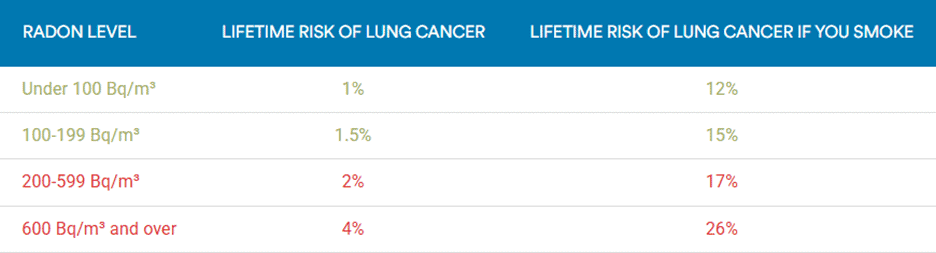
Image used with permission. © 2026 takeactiononradon.ca.
As you can see, smoking is an immense risk for lung cancer, but high radon can increase that risk significantly. Furthermore, on the topic of smoking, the harm done to your body from cigarette smoking is partly from radioactive elements found in cigarette smoke. I will talk more about where these elements are from in the next section and go into more detail about how much radiation you can get from cigarette smoking later in this article. But whether you are a smoker or not, if you have never tested your home for radon then you should test your home for radon. Testing is easy to do yourself with a long-term passive radon test kit, or you can hire a C-NRPP certified Radon Measurement Professional which you can find here: https://c-nrpp.ca/find-a-professional/. Radon and radon progeny makes up the largest part of your background radiation exposure, which in itself is not concerning since background radiation is natural and something we evolved with, but that also means that living in a home with elevated radon (for example, above the Health Canada recommended action level of 200 Bq/m3) would mean that you are exposed to a dose of radiation that is significantly above the average Canadian background radiation exposure.
Ingested Dose from Food and Water
So, radioactive elements are found throughout the environment and is what is responsible for the terrestrial radiation and for the inhaled radon dose. Terrestrial radiation is when the elements decay when they are in the soil and rocks, and the gamma radiation reaches us on the surface. Inhaled radon dose comes from radium in the ground decaying into radon gas and that gas makes its way to the surface where we can breathe it in. There is a third common way for radioactive elements in the environment to give us a dose of ionizing radiation and that way is through ingestion. Some atoms in the environment are radioactive, living things incorporate atoms into their bodies as they grow, therefore some atoms in living things are radioactive atoms. You may have heard about carbon dating. Living things use carbon for many purposes. Plants that photosynthesize can pull carbon from the atmosphere as carbon dioxide and turn them into sugars. Animals can eat plants and incorporate carbon from those sugars into their body to be used as fuel or to be stored as fats. Therefore, all living things on Earth will have carbon in their bodies and in fact are referred to as carbon-based lifeforms. Most of the carbon in your body is carbon-12, the most stable and common type of carbon, but some fraction of the carbon in your body will be carbon-14, which is slightly radioactive. This fact is what’s used by archeologists and geologists to figure out the age of certain artifacts or scientific samples. Carbon-14 is a very small contribution to your ingested dose. Most of our ingested dose comes from potassium-40, which we will talk about next.
Radioisotopes in Plants
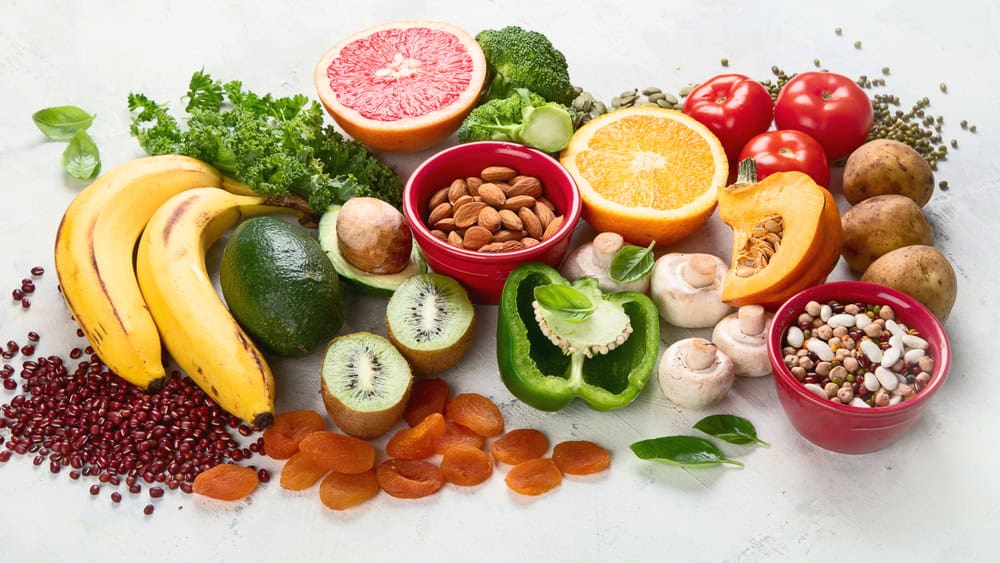
Focusing entirely on plants, these organisms require certain nutrients to grow. Gardeners know that fertilizers are often rated in terms of their NPK content, which stands for nitrogen-phosphorous-potassium content. Out of these, potassium has a common radioisotope called potassium-40. All plants need potassium to grow, and some of that potassium will be the radioactive potassium-40. This is the origin of the banana equivalent dose. Bananas, because of their relatively higher potassium content, give an internal dose of ionizing radiation from that potassium. An upper estimate on the radiation dose from a banana is 0.1 μSv (or 0.0001 mSv) and this is sometimes referred to as the banana equivalent dose of BED. There are many criticisms of BED since once we ingest the banana, the potassium is not retained by a human body forever but instead is controlled by our organs to maintain homeostasis (a balanced level of potassium in our body). And so, eating 10,000 bananas will not give you a dose of 1 mSv since the excess potassium will be filtered out by the kidney and peed out. However, BED can be useful for educational or illustrative purposes despite some inaccuracies in how the potassium in bananas work inside of our bodies. Bananas are also only one food that is high in potassium. A typical banana has approximately 500 mg of potassium. This is a similar amount of potassium as ½ cup of spinach or white beans, and a baked russet potato with the skin on can have 1000 mg of potassium. A common salt substitute is potassium chloride, and a teaspoon of potassium chloride will contain about 2500 mg of potassium. All these sources of potassium, when ingested, will temporarily increase your body’s potassium-40 content, which means there are more radioactive elements inside of you. An upper limit on how much ionizing radiation dose you get from ingesting potassium is 0.1 μSv for each 500 mg of potassium but that is not realistic since your body will get rid of the excess potassium if you have too much.
Brazil nuts are another common example of a plant food that can give you a dose of radiation. Brazil nuts contain high amounts of potassium but also radium. Together, this means that eating a large number of Brazil nuts daily can result in a radiation dose. If you are a fan of Brazil nuts, you already know that it is an excellent source of selenium, an essential nutrient for humans. However, eating too many Brazil nuts daily can lead to too much selenium. Daily Brazil nut consumption should be limited to less than 4 nuts a day to avoid getting too much selenium. A daily consumption rate of 2 Brazil nuts can result in a dose of 160 μSv/year or 0.16 mSv/year from the intake of radium and potassium in the nuts. This is the same annual dose as eating about 4.5 bananas a day for a whole year.
Radiation Dose from Smoking
This is also the reason cigarette smoke contains polonium-210. The tobacco plant pulls elements from the air and soil. And once dried and packed into cigarettes, that process concentrates certain elements leading to a relatively higher concentration of polonium-210 and other radioisotopes, which can give you a dose of radiation when you inhale the smoke. According to an article published in the Journal of Environmental Radioactivity, assuming a smoker smokes 20 cigarettes a day, every day for a whole year, their radiation dose from the inhalation of radioactive elements add up to about 1500 μSv/year or 1.5 mSv/year (Felix, 2024). This is the same amount of radiation as about 20 Brazil nuts or 40 bananas everyday for a whole year. Note that this is not the total harm of smoking, simply the radiation dose from cigarettes compared to other plant-based sources of ionizing radiation. Cigarettes are also harmful to us in many other ways, and quitting smoking will have a much higher impact on your health than any radiological concerns.
Radioisotopes in Animals
Grazing animals, due to their grass consumption, will consume potassium and thus potassium-40 when they graze. And when humans slaughter them for meat, we can consume some of that potassium-40 and other radioactive elements they have eaten. In Canada, Northern communities eat more moose meat, which will have higher amounts of potassium-40 compared to meats from non-grazing animals. Similarly, predatory fish will have a higher concentration of lead and polonium, and a fraction of that will be radioactive lead-210 and polonium-210. The radioactive elements make their way from the environment into plants and algae which are then consumed by animals and maybe then by predatory animals. This process of bioaccumulation can lead to higher concentrations of certain radioactive elements.
On average, Canadians ingest radioactive elements that contribute 0.3 mSv dose of radiation per year. This dose mostly comes from potassium-40, but also caesium-137, radium-226, and other isotopes. There is not a lot that can be done to reduce this dose short of not eating. Changing the kind of things you are eating may be able to affect that dose, but it is also important to ensure you are getting proper nutrition. There is no reason to avoid bananas since everything has potassium and it’s an essential nutrient. There is a reason to not eat too many Brazil nuts daily but that comes from too much selenium rather than the radiation within. We should avoid eating too much red meat and fish but more due to the other health effects rather than the radiation found in these products.
Food and Water Safety
Note that this is different from food irradiation for sterilization purposes. Some foods in Canada are exposed to ionizing radiation to kill pathogens or preserve freshness. Exposing food to radiation does not make the product radioactive. As explained previously, food is already slightly radioactive due to radioisotopes that exist in the environment. Exposing it to ionizing radiation does not affect the existing radioisotopes in those products and will not cause it to gain more radioisotopes. You can read more about food irradiation and its regulation in Canada here: https://www.canada.ca/en/health-canada/services/food-nutrition/food-safety/food-irradiation.html. Furthermore, water quality and food contamination are monitored in Canada by Health Canada’s Environmental and Radiation Health Sciences Directorate through their Radiation Protection Bureau in collaboration with other government agencies. Data from monitoring and testing are also shared with the Canadian Total Diet Study which has been tracking radionuclides in food and drink products since 2000. The radioisotopes that are tracked by the Total Diet Study include americium-241, caesium-134, caesium-137, cobalt-57, cobalt-60, iodine-131, lead-210, potassium-40, and radium-226. As for water, the latest version of “Guidelines for Canadian drinking water quality: Radiological parameters” was published in December 2025 and sets out maximum acceptable concentrations of lead-210, radium-226, and radium-228.
To summarize, Canadians receive an ionizing radiation dose from inhaled and ingested radionuclides. On average, the inhaled dose is 0.9 mSv/year, almost entirely from radon and radon progeny, and the ingested dose is 0.3 mSv/year, mostly from potassium-40 but also radium-226, uranium-238, and other radioisotopes. This can be compared with the background radiation dose from terrestrial sources, 0.2 mSv/year, and from cosmic sources, 0.3 mSv/year. The most impactful action you can take to reduce your radiation dose is to test your home for radon. If you live in a building with high radon, then the inhaled dose can be much higher than 0.9 mSv/year, putting you at greater risk of developing a fatal lung cancer. If you live in a house with average radon concentrations, don’t smoke or fly on a plane frequently, and you wear sunscreen and eat a varied diet, then you are likely at an average level of risk from radiological sources compared to the rest of Canada.
References
Canadian Cancer Society. (n.d.). Canadian Cancer Society. Retrieved from Radon: https://cancer.ca/en/cancer-information/reduce-your-risk/know-your-environment/radon
CNSC. (2023, 3 30). Radiation doses. Retrieved from Canadian Nuclear Safety Commission: https://www.cnsc-ccsn.gc.ca/eng/resources/radiation/radiation-doses/
Cross-Canada Survey of Radon working group: a collaboration between the Evict Radon National Study, B. C. (2024, October). Cross-Canada Survey of Radon Exposure in the Residential Buildings of Urban and Rural Communities. Retrieved from Radon Levels Across Canada: https://crosscanadaradon.ca/survey/#Radon_Levels_Across_Canada
Felix, A. N. (2024). Review of natural radioactivity in tobacco cigarette brands. Journal of Environmental Radioactivity, 107348.
Take Action on Radon. (n.d.). Retrieved from Smoking and Radon: https://takeactiononradon.ca/smoking-and-radon/